

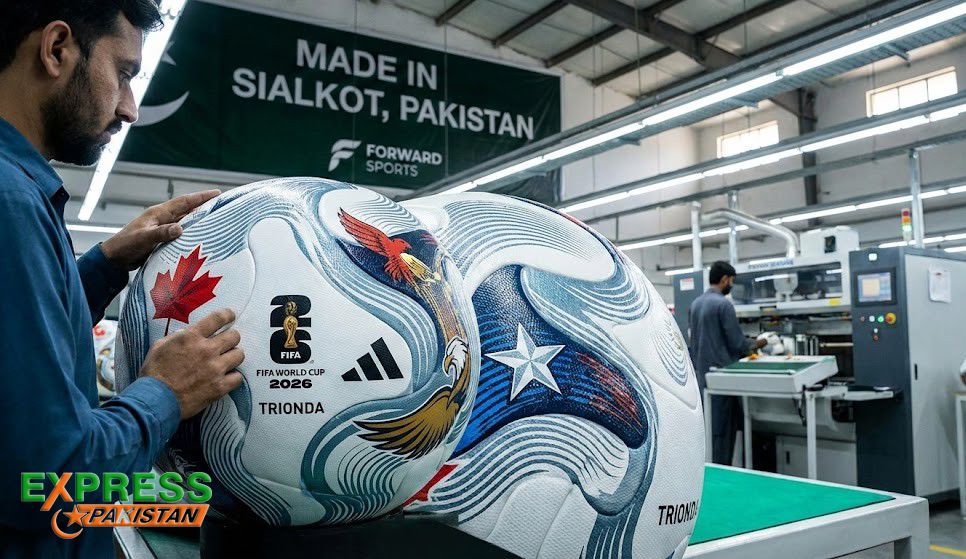
Sialkot, Pakistan — The historic city of Sialkot has once again secured its place on the global football map. Pakistan’s sporting capital has been selected to manufacture Trionda, the official match ball for the FIFA World Cup 2026. This landmark decision is a powerful testament to Pakistan’s unmatched expertise in football manufacturing and reinforces Sialkot’s enduring reputation as the world’s premier sports goods production hub.
What is Trionda?
Trionda is the official match ball of the FIFA World Cup 2026, the most-watched sporting event on the planet. The name combines two powerful ideas — “Tri” symbolizes the three host countries of the tournament, the USA, Canada, and Mexico, while “Onda” translates to “wave” in Spanish. Together, the name reflects both the unification of three nations and the dynamic spirit of the beautiful game.
The ball’s design celebrates each host nation through bold visual details. A USA star, a Canadian maple leaf, and a Mexican eagle appear as graphics and embossed textures across the surface. The four panels meet at the centre in a triangle pattern, symbolizing the historic three-nation partnership that makes this World Cup truly unique.
The AI Sensor Technology Inside Trionda
This is where Trionda truly sets itself apart from every World Cup ball that came before it. The ball is equipped with state-of-the-art Connected Ball Technology developed by Adidas. At its core is a sophisticated 500Hz motion sensor chip that delivers real-time data on every element of the ball’s movement throughout each match.
The sensor chip weighs just 14 grams but performs a major role during games. It constantly monitors and transmits data on speed, spin, direction, and the exact point of impact every time a player touches the ball. Unlike traditional footballs that simply serve as playing equipment, Trionda functions as a highly advanced real-time data collection device.
The sensor measures acceleration, rotation, and movement in three dimensions, feeding data to stadium systems continuously throughout the match. This information is sent directly to the Video Assistant Referee system, where it is combined with artificial intelligence to produce faster and more accurate decisions on offside calls, handball incidents, and potential red card situations. Every individual touch of the ball can be tracked with pinpoint precision.
Adidas redesigned the sensor placement for Trionda compared to previous models. The chip is embedded into a dedicated pocket inside one of the ball’s side panels, with carefully positioned counterweights added across other sections to preserve proper balance and aerodynamic performance. Despite the added technology, the ball fully meets all official FIFA regulations regarding weight, bounce, and overall performance. Players will feel no difference whatsoever during play.
Charging the Smart Ball
The Connected Ball Technology inside Trionda requires charging before each match. The sensor battery is charged wirelessly via a specialized charging station — no cables required. The ball takes approximately 90 minutes to fully charge and remains operational for nearly 6 hours. When the ball leaves the field, the sensors automatically switch to hibernation mode to conserve battery life.
Beyond officiating support, the system also collects valuable analytical data including the number of touches, ball speed, and player load during the match. Trionda is therefore not only a playing instrument but a full-fledged football analytics tool.
Four-Panel Design and Performance Engineering
Trionda features a seamless surface with fine texture and strategic debossing for precision passing and shooting. It is the first World Cup ball to be rigorously tested across the diverse climates and altitudes of all 16 host cities, ensuring consistent performance whether played in Vancouver’s cool rain or at Mexico City’s high elevation.
The revolutionary four-panel construction is a major departure from previous World Cup balls. The 2022 Al Rihla had 20 panels and the 2014 Brazuca had six. Trionda’s four-panel design reduces drag, improves aerodynamics, enhances flight stability, and delivers greater shooting accuracy. Deep seams and specially pressed lines ensure uniform air resistance throughout the ball’s flight path.
Why Sialkot Was Chosen to Produce Trionda
To understand why FIFA and Adidas entrusted the production of Trionda to Sialkot, one must appreciate the scale and depth of the city’s football industry. Sialkot produces an estimated 40 to 70 percent of the world’s footballs, supplying professional leagues, national teams, and international tournaments across the globe. The city is home to hundreds of certified manufacturers, thousands of skilled artisans, and a well-established supply chain capable of delivering both quality and volume at scale.
The workforce behind Trionda is generational. Many factory workers today are third or fourth-generation football makers, having inherited precision techniques from their parents and grandparents. This blend of inherited craftsmanship and modern manufacturing technology is what sets Sialkot apart from any other production center in the world.
Sialkot’s factories have also consistently passed FIFA’s Quality Programme inspections — among the most rigorous product certification processes in international sports. This ongoing compliance is a key reason why global sporting brands continue to trust Sialkot for their most prestigious projects, including Trionda.
A Historic Milestone for Pakistan
The selection of Sialkot to manufacture Trionda has been celebrated across Pakistan as a moment of immense national pride. For a country that has quietly powered the global football industry for over a century, this recognition on the grandest stage possible is both deserved and long overdue.
Trade and industry officials have described the Trionda contract as more than a commercial achievement — it is a brand statement for Pakistan on the international stage. It proves that Pakistani industry can meet the world’s highest quality standards, on time and at scale.
The Economic Impact of Trionda Production
The manufacturing of Trionda will deliver a significant boost to Pakistan’s economy. The sports goods export sector — already one of the country’s most reliable sources of foreign exchange — will benefit from increased global orders, heightened international visibility, and greater demand for skilled labor.
For small and medium-sized businesses in and around Sialkot, the ripple effects are equally significant. Raw material suppliers, logistics providers, packaging companies, and quality testing laboratories all benefit when a project of this magnitude arrives in the city. The Trionda production contract strengthens the entire local manufacturing ecosystem.
Pride, Passion, and a Global Legacy
Beyond economics, the Trionda project holds deep cultural meaning for Sialkot. Football is not merely an industry here — it is part of the city’s identity, its history, and its global legacy.
For the workers who will bond, test, and package every Trionda ball, knowing their craftsmanship will be felt in every kick, header, and goal at the FIFA World Cup is a source of extraordinary personal pride. Billions of people around the world will watch the 2026 tournament without knowing the ball on the pitch was made by skilled hands in Pakistan. But those hands — and that city — will know.
Sialkot is Ready
As FIFA World Cup 2026 draws closer, production planning in Sialkot is well underway. Quality benchmarks are being set, factories are being prepared, and workers are gearing up for one of the most prestigious manufacturing assignments in the city’s history.
The world’s attention will focus on the goals, the drama, and the stars performing across stadiums in the United States, Canada, and Mexico. But the story of Trionda — the smartest and most technologically advanced football ever made — begins long before the opening whistle, in the workshops and factories of Sialkot, where every great football has always been made with precision, passion, and pride.