

History of Space Ambitions and Achievements
SUPARCO Pakistan is the national space agency of Pakistan, established in 1961 to develop space science, rocket technology, and satellite systems. It has contributed significantly to the country’s scientific progress and technological development. Over time, the organization has expanded from basic rocket research to advanced satellite missions and space exploration projects.
Early History and Formation
SUPARCO was founded on September 16, 1961, with the goal of promoting space research and upper atmosphere studies. At that time, few developing countries had established space programs. Therefore, Pakistan became one of the earliest nations in Asia to invest in space science.
Initially, the focus remained on training scientists and developing technical expertise. In addition, the organization aimed to build long-term research capacity in aerospace fields.
Scientific Vision and Early Support
Dr. Abdus Salam played an important advisory role in shaping Pakistan’s early scientific direction. He strongly supported investment in advanced research, including space science.
Moreover, international cooperation helped strengthen early technical training. As a result, Pakistani engineers gained exposure to global research practices and methodologies.
Rehbar Rocket Program
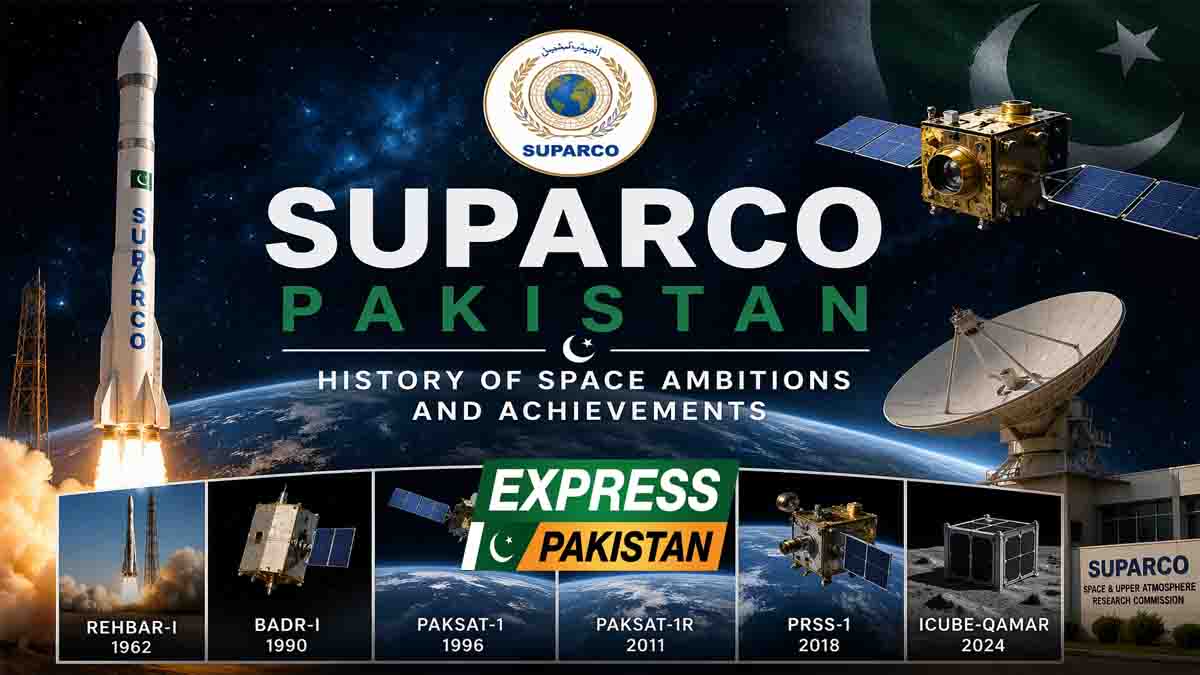
The first major milestone came in 1962 with the launch of Rehbar-I from Sonmiani in Balochistan. This sounding rocket reached an altitude of approximately 130 kilometers.
It was designed to study the upper atmosphere and collect scientific data. Subsequently, additional Rehbar rockets were launched during the 1960s to continue atmospheric research.
These missions helped develop expertise in rocket design, telemetry, and atmospheric physics.
Development Phase and Expansion
During the 1970s and 1980s, progress continued despite financial and political challenges. However, scientific training and research efforts remained active.
The organization gradually expanded into remote sensing and satellite planning. Consequently, Pakistan developed foundational knowledge for future space missions.
First Satellite Mission
A major breakthrough occurred in 1990 with the launch of Badr-I from China’s Long March rocket. This marked Pakistan’s entry into orbital space operations.
Engineers contributed to its design and development. Therefore, the mission represented an important scientific achievement for the country.
Later, Badr-B was launched in 2001 to support further research and communication experiments.
Communication Satellite Systems
Pakistan launched its first communication satellite, PakSat-1, in 1996. It supported television broadcasting and communication services across the country.
In 2011, PakSat-1R replaced and improved the system. As a result, internet access and digital communication coverage expanded significantly.
These satellites continue to support national communication infrastructure.
Modern Satellite Programs
In 2018, PRSS-1 was launched as an advanced Earth observation satellite. It provides high-resolution imaging for agriculture, disaster response, and urban planning.
Additionally, PakTES-1A was launched for experimental research and technology testing. These missions strengthened Pakistan’s remote sensing capabilities.
Lunar Exploration Achievement
A significant milestone came in 2024 when the iCube-Qamar CubeSat entered lunar orbit. This mission was carried out through China’s Chang’e-6 program.
It demonstrated Pakistan’s entry into lunar exploration efforts. Moreover, it showcased progress in miniaturized satellite technology and international collaboration.
Current Role and Focus
Today, the organization operates research centers in Karachi and Lahore. It also manages satellite control systems and training institutes.
Its main focus areas include:
- Earth observation systems
- Communication satellites
- Navigation technologies
- Space research programs
- International cooperation
Meanwhile, efforts continue to expand technological capabilities for future missions.
Timeline Overview
- 1961 – Space agency established
- 1962 – Rehbar-I rocket launch
- 1990 – Badr-I satellite mission
- Mid-1990s – PakSat-1 leased communications satellite becomes operational
- 2001 – Badr-B satellite launch
- 2011 – PakSat-1R upgrade
- 2018 – PRSS-1 Earth observation satellite
- 2024 – iCube-Qamar lunar mission
- 2026 – Pakistan EO-3 Satellite – PRSC-EO3 / EO-3 Earth observation satellite launched (China, Long March-6)
Conclusion
In conclusion, SUPARCO Pakistan has played a steady role in developing space science and satellite technology. It began with early rocket experiments and later progressed into satellite and lunar missions.
Over the decades, it has supported communication systems, Earth observation, and research development. Therefore, its evolution reflects Pakistan’s growing participation in global space science.
