

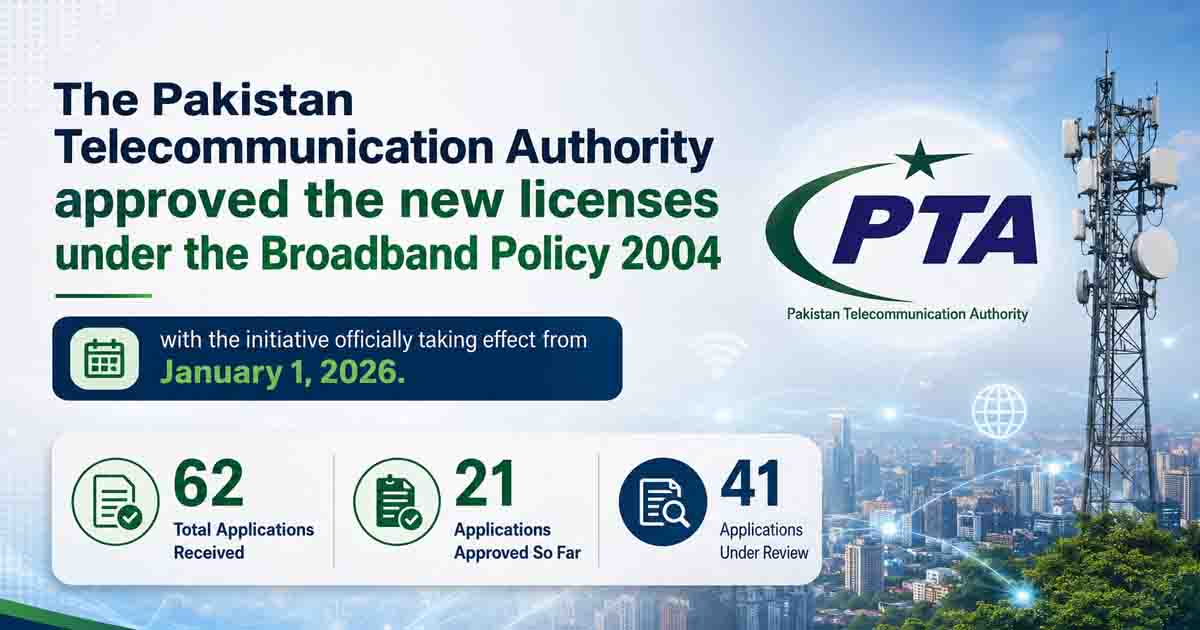
PTA Internet Licenses have been issued to 21 new district-level internet service providers across Pakistan — a move that marks one of the most significant steps toward grassroots broadband expansion the country has seen in years.
The Pakistan Telecommunication Authority approved the new licenses under the Broadband Policy 2004, with the initiative officially taking effect from January 1, 2026. Out of 62 total applications received, 21 have been approved so far, while the remaining 41 are still under review.
Also Read: Punjab Satellite Internet: Connect the Unconnected — A Powerful Plan
What Are the New PTA Internet Licenses?
The new PTA Internet Licenses are district-level class licenses — a framework designed specifically to lower the entry barrier for smaller, regional internet providers who cannot compete at the national level but can serve a single district effectively.
Each license is valid for 10 years and is issued exclusively for one district per entity. This structured approach gives operators long-term stability to invest in local infrastructure without overextending their resources.
The fee structure is clear and predictable. Providers pay an application processing fee of Rs. 20,000, an initial license fee of Rs. 300,000, and an annual renewal fee of Rs. 100,000 — which increases by 10 percent each year over the license term.
What Are the Requirements for Licensed Providers?
The PTA has set firm performance benchmarks to ensure licenses translate into real connectivity rather than remaining on paper.
Licensed operators must begin offering internet services within one year of receiving their license. Within one year of obtaining their commencement certificate, each provider must establish a minimum of 100 broadband connections in their district.
For bandwidth sourcing, operators can connect through PTCL, Long Distance and International (LDI) licensees, or Local Loop (LL) licensees. On the infrastructure side, providers have multiple options: they can use last-mile networks from existing operators, build on PEMRA-issued Cable TV license infrastructure, or lay their own infrastructure if they cannot secure access from existing operators within three months of trying.
Why These PTA Internet Licenses Matter
Pakistan already has over 200 licensed internet service providers nationally. However, the vast majority of those providers concentrate their networks in major urban centres — Karachi, Lahore, Islamabad, and a handful of other cities.
District-level PTA Internet Licenses directly challenge this imbalance. By creating a legal and financial pathway for smaller, locally rooted operators to enter the market, the PTA is targeting connectivity in the specific districts and union councils where national ISPs have little commercial incentive to invest.
The expected outcomes are straightforward. More providers in underserved districts means more competition, which typically drives prices down and forces service quality improvements. Rural schools, clinics, freelancers, and small businesses that have long operated without reliable broadband are the primary beneficiaries.
Impact on Pakistan’s Digital Economy
Stronger broadband coverage at the district level is not only a convenience upgrade — it is an economic enabler. Pakistan’s freelancing sector alone earns hundreds of millions of dollars annually, yet large portions of the country’s talent pool remain excluded simply because reliable internet access does not reach them.
The same connectivity gap limits digital education platforms, telemedicine adoption, e-commerce penetration in rural markets, and the ability of local startups to operate competitively.
The new PTA Internet Licenses are a foundational step toward closing this gap. Combined with the federal government’s ongoing satellite internet regulatory framework and Punjab’s Connect the Unconnected mission, the push toward nationwide broadband coverage is accelerating from multiple directions simultaneously.
What Comes Next
The PTA has confirmed that the remaining 41 applications for district-level internet licenses are still under review. More approvals are expected, which would further expand the number of districts with licensed local providers.
The strong response — 62 applications for a brand-new licensing category — signals that demand from local entrepreneurs and regional telecom players is real and significant. If the approved operators meet their deployment targets within the required 12-month window, Pakistan could see measurable broadband expansion in previously underserved districts before the end of 2026.
The PTA Internet Licenses initiative is not a headline policy announcement. It is a structural change — and structural changes, when implemented well, tend to last.
