

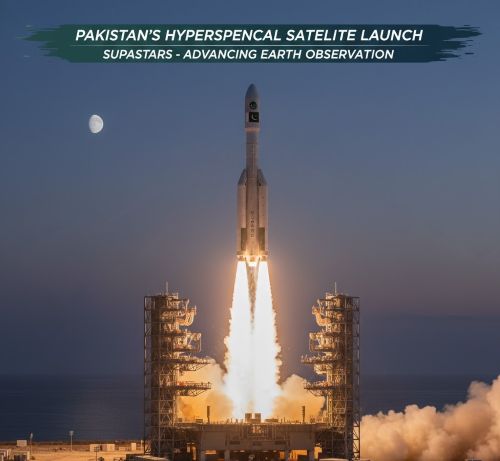
Pakistan Launches First Hyperspectral Satellite HS-1: A New Era in Space Technology
Overview
Pakistan has officially entered an elite group of space-faring nations after the successful deployment of its first Hyperspectral Satellite (HS-1). The Pakistan Space and Upper Atmosphere Research Commission (SUPARCO) confirmed that the satellite reached orbit after its launch from China’s Jiuquan Satellite Launch Center. This milestone marks a major advancement in Pakistan’s space and Earth observation capabilities.
What Makes HS-1 Special?
The HS-1 satellite represents a major technological leap in Earth observation. It is equipped with advanced hyperspectral imaging systems that capture data across hundreds of narrow spectral bands. As a result, the satellite can detect subtle variations in light that traditional satellites cannot identify. Therefore, it provides highly detailed and accurate information about Earth’s surface. In addition, this technology allows scientists to analyze environmental changes with far greater precision than before.
Key Applications of the Satellite
The deployment of HS-1 is expected to benefit several important sectors in Pakistan. Firstly, it will support precision agriculture by monitoring crop health, soil conditions, and irrigation needs. Consequently, farmers can improve productivity and reduce resource waste. Moreover, HS-1 will help track deforestation, pollution levels, and water quality, which supports environmental protection and sustainable planning. In addition, urban planners can use satellite data to manage infrastructure development, including transportation systems and land use planning. Most importantly, HS-1 will improve disaster response systems by helping predict floods and monitor affected areas more effectively, allowing faster emergency action.
Importance for CPEC Projects
The satellite also plays a strategic role in the China-Pakistan Economic Corridor (CPEC). Notably, its imaging capabilities can identify geological risks along infrastructure routes. Therefore, engineers and planners can design safer roads, bridges, and energy projects. This improves long-term sustainability and reduces construction risks in challenging terrains.
Strengthening Pakistan–China Space Cooperation
The launch highlights strong collaboration between Pakistan and China in space technology. The satellite was launched from China’s Jiuquan Satellite Launch Center, reflecting ongoing partnership in scientific development. Deputy Prime Minister Mohammad Ishaq Dar praised the teams from both countries and emphasized that this achievement reflects a shared commitment to peaceful space exploration and technological progress. Furthermore, this collaboration strengthens cooperation in science, research, and innovation.
A Major Step for Pakistan’s Space Program
The HS-1 satellite marks a new chapter in Pakistan’s space journey. It demonstrates SUPARCO’s growing technical capability and expanding role in advanced space missions. In addition, it shows Pakistan’s increasing focus on using space technology for national development. Ultimately, HS-1 is not only a scientific success but also a step forward in environmental monitoring, disaster management, and sustainable planning.
Final Outlook
In conclusion, the successful launch of HS-1 is a significant milestone for Pakistan. It strengthens the country’s position in global space technology and opens new opportunities for scientific advancement. As a result, Pakistan is now better equipped to use space-based data for national planning and development. This achievement signals a stronger, more advanced, and technology-driven future for the country.
