

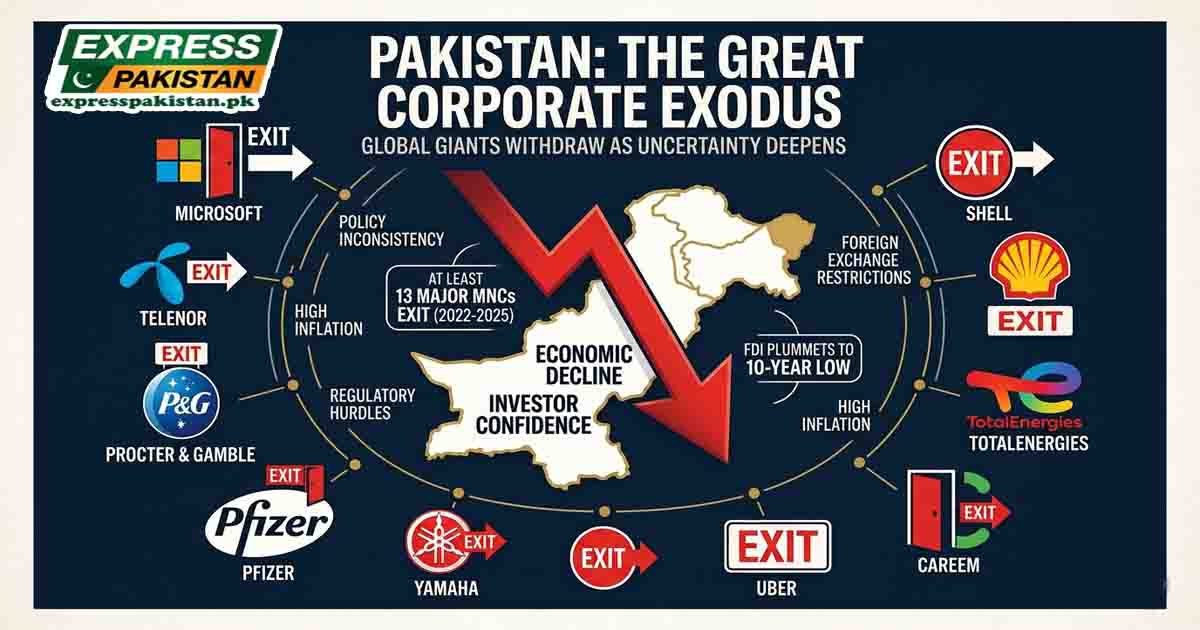
Foreign Companies That Left Pakistan: 14 Giants Gone in 5 Years
Foreign companies that left Pakistan between 2021 and 2025 have delivered a warning that the country can no longer afford to ignore. Microsoft, Shell, Pfizer, Telenor, Procter & Gamble. One by one, multinationals that operated in Pakistan for decades — some for over 70 years — have walked away from a market of 240 million people.
According to the Securities and Exchange Commission of Pakistan (SECP), 125 foreign companies had stopped operating in Pakistan as of January 2026. This is not a bad year. It is a pattern.
The Numbers Behind the Exodus
Pakistan attracted just $808 million in FDI during the first half of fiscal year 2025–26 — a 43% decline compared to $1.425 billion in the same period the year before. The drop reflects not a single shock but a sustained loss of confidence that has been building since 2022.
| Metric | Figure |
|---|---|
| FDI drop in H1 FY2026 | -43% |
| Foreign firms exited by Jan 2026 | 125 |
| FDI lost vs previous year | $617 million |
| Tech startup funding 2024 | $50M (down from $366M in 2021) |
Full List: Foreign Companies That Left Pakistan
I can see the issue — the “Year” column is breaking into two lines and the table is too wide. Here is the fixed version:
Copy Paste Ready — Fixed Table
| Company | Sector | Year | What Happened |
|---|---|---|---|
| Microsoft | Technology | 2025 | Closed office after 25 years, cited political chaos |
| Careem | Transport | 2025 | Suspended ride-hailing, low investor confidence |
| Yamaha Motor | Manufacturing | 2025 | Shut down motorcycle production |
| Procter & Gamble | Consumer Goods | 2025 | Wound down manufacturing including Gillette |
| TotalEnergies | Energy | 2024 | Sold 50% stake in Total PARCO |
| Pfizer | Pharma | 2024 | Sold Karachi plant to Lucky Core Industries |
| Uber | Transport | 2024 | Discontinued ride-hailing operations |
| Telenor Pakistan | Telecom | 2023 | Sold to PTCL after heavy losses |
| Shell Pakistan | Energy | 2023 | Divested after 76 years in Pakistan |
| Bayer | Pharma | 2023 | Divested local assets to OBS Group |
| Sanofi-Aventis | Pharma | 2023 | Sold 52.87% stake to Packages Group |
| Fresenius Kabi | Pharma | 2023 | Discontinued citing poor business climate |
| Eli Lilly | Pharma | 2022 | Ceased ops, moved to local distributor |
| Puma Energy | Energy | 2022 | Divested Admore Gas shareholding |
Why They Left: 5 Root Causes
1. Profits Were Trapped Inside Pakistan
At its peak in 2023, over $1 billion in blocked dividends were awaiting clearance, forcing companies to absorb mounting currency losses on their balance sheets. When a company cannot repatriate its own earnings, no business case exists to stay.
2. Policies Changed Without Warning
Companies reported being blindsided by retrospective tax demands and abrupt changes in import rules, disrupting years of business planning and operations. Investors can survive a bad policy. They cannot survive unpredictable ones.
3. Import Restrictions Paralysed Supply Chains
The government’s sweeping import restrictions between 2022 and 2024 affected firms reliant on imported raw materials and machinery, leading to halted production lines and forced reevaluation of long-term presence in the country.
4. The Consumer Market Shrank
Expenditure on food now makes up about 65% of the poorest households’ budget in 2024–25, up from 47% in 2017–18. With families spending nearly two-thirds of income on food, demand for everything else collapsed. The middle-class consumer market that once attracted these multinationals had fundamentally disappeared.
5. Informal Economy Priced Out Formal Business
An entity operating formally and complying with all regulatory requirements is effectively priced out of the market by smuggled goods and informal competitors who pay no taxes, no duties, and no compliance costs. Multinationals that play by the rules simply cannot compete.
What Each Sector Lost
| Sector | Companies Lost | Key Impact |
|---|---|---|
| Pharmaceuticals | 5 — Pfizer, Bayer, Sanofi, Eli Lilly, Fresenius | Medicine supply, R&D investment, healthcare jobs |
| Energy | 3 — Shell, TotalEnergies, Puma Energy | Fuel supply chain, downstream investment |
| Transport & Tech | 3 — Uber, Careem, Microsoft | Digital economy, ride-hailing, software ecosystem |
| Consumer Goods | 1 — P&G / Gillette | FMCG manufacturing, retail employment |
| Telecom | 1 — Telenor | $376 million FDI outflow from Norway alone |
| Manufacturing | 1 — Yamaha | Motorcycle production, engineering jobs |
What Pakistan Must Do Now
The exits are reversible — but only with genuine reform, not press conferences.
Unblock profit repatriation. This is the single fastest way to signal that Pakistan respects foreign investors. Without it, no serious multinational will commit capital here.
Stabilise tax and import policy. Every surprise policy change that hits a foreign company gets reported to every other foreign company’s board. Word travels fast.
Formalise the economy. Countries like Bangladesh and the UAE have positioned themselves as attractive investment destinations through proactive economic reforms and investor incentives — while Pakistan continues losing ground to smuggling and grey markets that make formal business unviable.
Restore political stability. No boardroom in London, Tokyo, or New York will approve a Pakistan investment while the country’s political and institutional environment remains unpredictable. Stability is not a soft requirement — it is the foundation everything else rests on.
Conclusion
The list of foreign companies that left Pakistan is a verdict on five years of economic mismanagement, policy inconsistency, and investor neglect. Shell stayed for 76 years. Microsoft stayed for 25. Telenor stayed for 18. These companies did not leave because Pakistan ran out of potential. They left because the environment made staying irrational.
Pakistan has the population, the location, and the talent to compete for global investment. But potential alone does not retain multinationals. Credibility does. Consistency does. Rule of law does.
The next five years will show whether Pakistan has learned that lesson.