

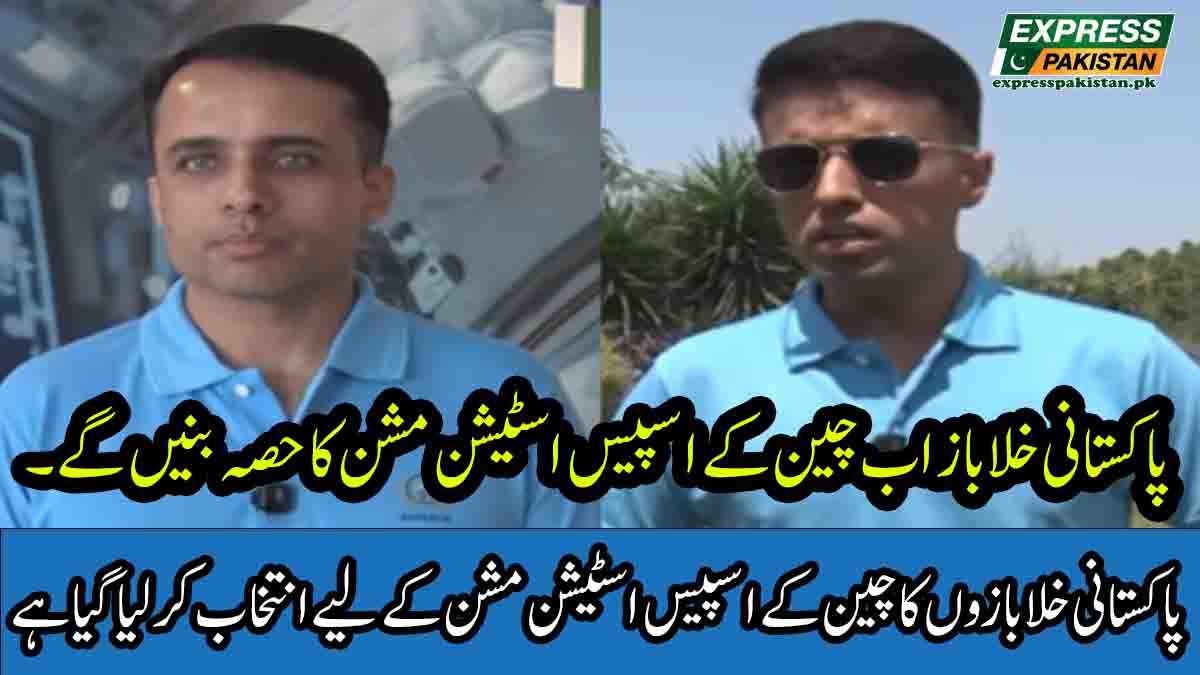
Pakistan has taken a giant leap into the future of space exploration. Two Pakistani astronauts — Muhammad Zeeshan Ali and Khurram Daud — have been formally chosen to undergo advanced training inside China for a potential mission to the China Space Station. Chinese state media confirmed the development, describing it as a defining chapter in the long-standing friendship between the two nations.
After completing their training at the Astronaut Centre of China (ACC), the two candidates will face a comprehensive assessment. Whichever astronaut clears the final evaluation will board a spacecraft bound for China’s Tiangong orbital station — earning the rare distinction of being the first foreign national ever to set foot inside the China Space Station.
🛰️ Quick Facts:
- Astronauts selected: Muhammad Zeeshan Ali & Khurram Daud
Agency: SUPARCO (Pakistan’s national space body)
Training venue: Astronaut Centre of China (ACC), Beijing
Historic first: One will become the first foreign astronaut inside Tiangong
Mission status: Confirmed by Chinese state media, April 2026
Two Names. One History-Making Seat.
The dual selection is by design. Both Muhammad Zeeshan Ali and Khurram Daud will travel to China and undergo the same rigorous preparation programme that China trains its own taikonauts on. Only after completing every stage of assessment will a final decision determine who occupies the single mission seat.
Video:
Meet Pakistan’s astronauts that are going to be living in space later this year:
Pakistan’s space agency, the Space and Upper Atmosphere Research Commission (SUPARCO) announces a landmark advancement in Pakistan’s Manned Space Mission Program as two Astronaut Candidates, Khurram… pic.twitter.com/qo01L32e45
— The STRATCOM Bureau (@OSPSF) April 22, 2026
This selection model mirrors how many space agencies handle high-stakes missions — pairing candidates to maintain readiness at every stage while ensuring the strongest performer reaches orbit. For Pakistan, both men already represent a victory. Their selection confirms that SUPARCO has developed human capital capable of meeting the demanding standards of one of the world’s most advanced space programmes.
What Training at the Astronaut Centre of China Involves
The Astronaut Centre of China, situated in Beijing, is the nerve centre of China’s entire crewed spaceflight programme. It is where China selects, trains, and certifies every taikonaut who has ever flown aboard a Shenzhou spacecraft or lived on Tiangong.
Training at the ACC typically covers several demanding disciplines:
- Spacecraft systems and emergency procedures — understanding every component of the Shenzhou crew vehicle
- Extravehicular activity (spacewalk) training — practised in neutral-buoyancy pools simulating microgravity
- Microgravity adaptation — parabolic flight exercises to prepare the body for weightlessness
- Mission science and payload operations — hands-on training with the experiments carried aboard Tiangong
- Mandarin language proficiency — required for communication with Chinese mission control
- Survival and rescue training — land and water recovery scenarios after re-entry
Completing this curriculum is no small achievement. The fact that Pakistan now has two candidates entering this pipeline places it in exceptionally rare company on the global stage.
This achievement marks a major milestone in the enduring friendship between China and Pakistan — a friendship that now reaches beyond Earth. — Chinese State Media, April 2026
Pakistan’s SUPARCO and the Road to the China Space Station
Founded in 1961, SUPARCO holds the distinction of being Asia’s first national space agency — predating even India’s ISRO. Yet for decades, Pakistan’s space ambitions remained largely confined to satellite development and remote sensing. The selection of two SUPARCO candidates for a crewed Chinese mission therefore represents the most consequential step forward in Pakistan’s six-decade space journey.
This is not the first time Pakistan and China have collaborated in space. Pakistan has previously launched remote sensing satellites with Chinese assistance, including the PAKSAT and PakTES series. However, sending a human being to an orbital station is an entirely different order of magnitude. It demands infrastructure, training, diplomatic trust, and technical readiness that only a handful of nations on Earth possess.
Pakistan, through this agreement, has joined that group.
Why the China Space Station Is Opening Its Hatches to Pakistan First
China has repeatedly stated that Tiangong is not a closed programme. In 2019, the China Manned Space Agency announced its intention to invite astronauts from United Nations member states to train and fly on the station. Several nations have expressed interest, but concrete bilateral agreements have moved slowly.
Pakistan’s selection ahead of other countries is therefore noteworthy. It reflects the extraordinary depth of the Pak-China relationship — often described by both governments as an “all-weather strategic partnership.” Space cooperation, in this context, is not simply a scientific endeavour. It is a powerful symbol of political alignment and mutual trust at the highest levels.
Beyond politics, Pakistan also offers something practical: a young, growing population with significant engineering and science talent, and a state-sponsored space agency actively seeking to build capacity. For China, partnering with Pakistan on a crewed mission creates a model that can be replicated with other friendly nations in the years ahead.
Step-by-Step: Pakistan’s Path to the China Space Station
- Official Selection Announced
Muhammad Zeeshan Ali and Khurram Daud are confirmed as Pakistan’s two astronaut candidates. Chinese state media formally acknowledges their selection, marking SUPARCO’s entry into crewed spaceflight. - Advanced Training in China
Both astronauts begin intensive training at the Astronaut Centre of China in Beijing. The curriculum covers everything from spacecraft systems to microgravity survival techniques. - Final Mission Assessment
After training concludes, both candidates undergo a comprehensive evaluation. Medical readiness, psychological fitness, technical performance, and mission compatibility are all assessed. - Launch & Historic Entry into Tiangong
The selected astronaut launches aboard a Shenzhou spacecraft and docks with the China Space Station — entering history as the first foreign national ever to cross the threshold of Tiangong.
What This Moment Means for Pakistan’s Future in Space
The significance of this development extends well beyond a single spaceflight. When a Pakistani astronaut finally floats through the hatch of the China Space Station, it will signal to the world — and to Pakistan’s own people — that the country is a credible participant in the new era of human spaceflight.
Domestically, the impact could be transformative. Pakistan has one of the world’s youngest populations, with millions of students currently studying science and engineering. A visible, living example of a Pakistani in space has the potential to reshape career aspirations on a generational scale — much as the Apollo missions reshaped American ambitions in the 1960s and 70s.
There are practical gains as well. The knowledge transfer from training at the ACC, the relationships forged with Chinese space scientists and engineers, and the data gathered during the mission will all feed back into Pakistan’s own long-term space roadmap. SUPARCO has publicly stated its ambition to develop indigenous launch capability and a domestic satellite programme. This mission accelerates that timeline.
🌍 Global Context: No foreign astronaut has ever entered the China Space Station since it became fully operational in 2022. Pakistan’s Muhammad Zeeshan Ali or Khurram Daud will be the first — a milestone that places Pakistan in the same historic register as the first astronauts from non-superpower nations to reach orbit.
China and Pakistan: A Partnership That Now Touches the Stars
The Pak-China relationship has evolved dramatically over the past two decades. What began as a Cold War-era strategic alignment has grown into a comprehensive economic, military, and now scientific partnership. The China-Pakistan Economic Corridor (CPEC) has already committed hundreds of billions in infrastructure investment. Military cooperation is deep and multi-layered. Cultural exchanges are expanding steadily.
Space collaboration is the newest and arguably most visible dimension of this partnership. It carries a symbolic power that roads, power plants, and port deals simply cannot match. A Pakistani flag on the wall of an orbital space station, 400 kilometres above Earth, speaks in a language that transcends borders and politics.
China’s statement — that this mission represents a “major milestone in the friendship between both countries” — is understated. It is, in fact, a moment that both nations will reference for decades.
Final Thoughts: Pakistan Reaches for the Stars
The selection of Muhammad Zeeshan Ali and Khurram Daud is not merely a news event. It is a turning point. It marks the moment Pakistan stopped being a spectator to humanity’s expansion into space and became, decisively, a participant.
One of these two men will soon look down at Earth from an altitude no Pakistani has ever reached before. Whether it is Zeeshan or Khurram who takes that seat, Pakistan wins either way — and so does every young student in Karachi, Lahore, Peshawar, or Quetta who dares to dream of the sky.
