

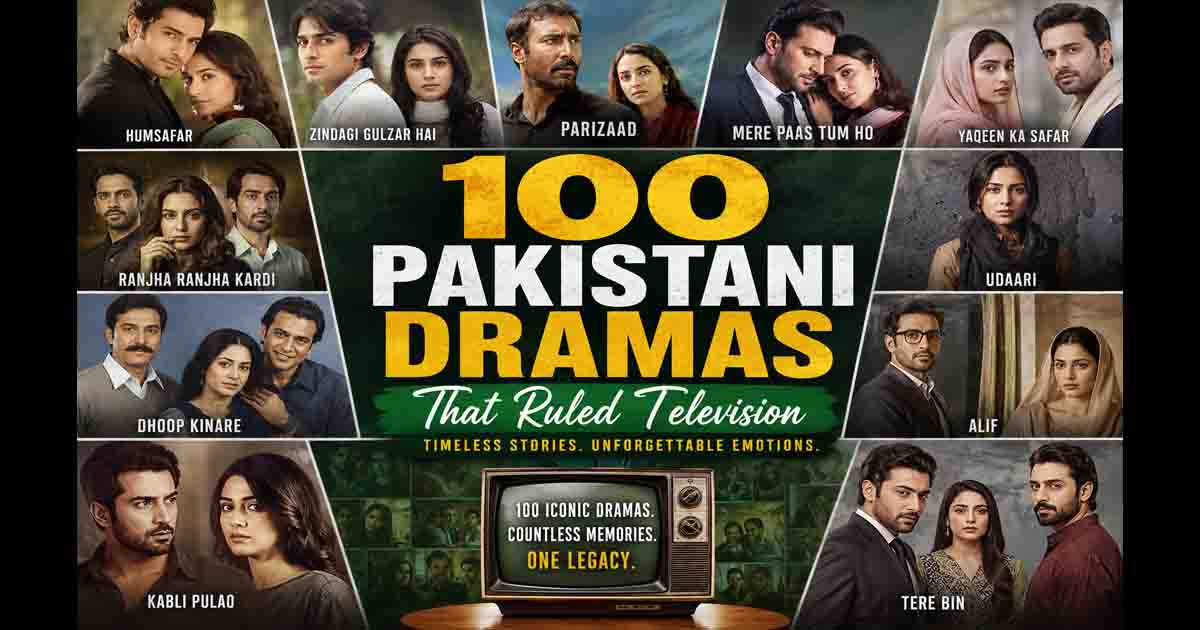
A journey through 25 years of unforgettable stories, iconic performances, and the shows that shaped a nation’s soul.
There’s something deeply special about Pakistani television. For over two decades, it has been a window into the country’s heart — reflecting its joys, contradictions, social struggles, and undying capacity for love. From the early 2000s, when private channels began reshaping the landscape, to the streaming era of the 2020s where Pakistani dramas found fans across continents, the medium has never stopped evolving.
Behind this rich legacy are the writers who gave words to human longing — Umera Ahmed, Farhat Ishtiaq, Khalil-ur-Rehman Qamar, Hashim Nadeem — and directors who turned modest budgets into cinematic art: Sarmad Khoosat, Mehreen Jabbar, Haissam Hussain, Nadeem Baig. Together, they built something extraordinary.
Here is a tribute to 100 Pakistani dramas that ruled television forever — from timeless classics to modern masterpieces.
Also Read:
- 20 New Pakistani Dramas 2026: Powerful Serials
- Green Entertainment Channel: 15 Must-Watch Dramas
- Top 10 Pakistani Dramas 2026: Biggest Hits Airing Right Now
🕰️ The Early 2000s: Rebuilding the Golden Age (2000–2006)
1. Ankahi Revisited (2000)
A one-off reunion special that brought back the beloved Ankahi cast to revisit their characters two decades later. Witty, nostalgic, and warm — it reminded a new generation why Haseena Moin’s writing was so beloved, and showed that great characters never really age.
2. Ain (2002)
An anthology series tackling moral dilemmas — from media manipulation to gender injustice — through stand-alone episodes. Sania Saeed and Nauman Ijaz brought weight and credibility to each story. A forgotten Pakistan Television Corporation (PTV) treasure that proved TV could educate as powerfully as it entertains.
3. Ab Tum Ja Sakte Ho (2001)
A compassionate and witty look at widowhood and society’s expectations of women who dare to start over. Haseena Moin’s signature blend of humor and empathy made this a mainstream hit without sacrificing its message.
4. Landa Bazar (2002)
Set in the narrow lanes of Lahore, this drama introduced Pakistani audiences to Khalil-ur-Rehman Qamar’s fiery, poetic dialogue. With themes of honor, love, and betrayal woven into a gritty urban setting, it became a cult classic — and helped launch Ali Zafar’s early career.
5. Koi To Barish (2002)
One of Umera Ahmed’s earliest gems — a quiet, spiritual story about a young woman healing from heartbreak through faith. Nadia Jamil’s nuanced performance and the rain-drenched metaphors foreshadowed the introspective dramas that would define the next decade.
6. Mehndi (2003)
Four sisters, four marriages, four very different lives — Mehndi was ensemble storytelling at its finest long before it was fashionable. It launched Ayesha Khan and Humayun Saeed into stardom, and its wedding song played at real Pakistani weddings for years afterward.
7. Aandhi (2003)
A politically bold drama about a woman who rises from domestic abuse to become a provincial minister, only to discover that patriarchy doesn’t stop at office doors. Years ahead of its time, Aandhi remains one of the bravest female-led stories ever put on Pakistani screens.
8. Umrao Jaan Ada (2003)
A lavish adaptation of the Urdu literary classic, this period drama told the story of a courtesan whose brilliance couldn’t protect her from society’s cruelty. Bushra Ansari’s commanding presence gave moral balance to the tragedy.
9. Aik Nazar Meri Taraf (2004)
An early Umera Ahmed story exploring the collision between ambition and ethics in modern urban life. Imran Abbas and Savera Nadeem brought quiet intensity to this understated, thoughtful drama.
10. Kash Aisa Ho (2004)
One of the first private-channel dramas to tackle child rights and corruption without resorting to melodrama. Directed by the gifted Iram Parveen Bilal, it paved the way for Geo TV’s more socially conscious programming.
11. Thora Sa Asman (2004)
A middle-class mother’s quiet struggle to give her children a decent future — told without flashy sets or dramatic twists, just honest emotion and strong performances. Simple, profound, and deeply moving.
12. Aashti (2005)
A domestic worker falls in love with her employer’s son in this bold commentary on class and gender in Pakistani society. Humayun Saeed and Resham delivered performances that challenged comfortable assumptions about privilege.
13. Tum Se Kehna Tha (2005)
Farhat Ishtiaq’s early work — a romance between college friends reunited years later, clouded by family rivalry and unspoken feelings. It established her signature style: love stories grounded in real human complexity.
14. Jhumka Jaan (2005)
A small-town girl navigates the glamour and cost of a modeling career — among the first dramas to examine how the media industry objectifies women. Stylistically bold and narratively brave.
15. Dil Ka Darwaza (2005)
A young idealistic doctor meets institutional corruption head-on in this socially resonant drama. Its theme song became an unlikely anthem of resilience.
16. Mujhe Apna Naam O Nishan Mila (2006)
A privileged young woman loses everything through arrogance and eventually finds her way back through humility and spiritual awakening. A classic Umera Ahmed morality tale, anchored by Faisal Qureshi’s powerful performance.
17. Tum Ho Ke Chup (2006)
A mother’s quiet strength holds her family together through secrets and deception. Penned by the legendary Bushra Ansari and directed with elegance — timeless female-led storytelling at its finest.
18. Meray Paas Paas (2006)
A married woman’s friendship with a male colleague tests social norms and her own emotional boundaries. Bravely written and subtly performed — a drama that was ahead of its time on questions of fidelity and fairness.
📺 The PTV Legacy Era (2007–2010)
19. Man O Salwa (2007)
A sweeping moral epic about the price of greed — drawn from the Quranic metaphor of divine blessings squandered. Nauman Ijaz’s portrayal of a spiritually fallen mentor remains one of television’s most unforgettable performances. Rahat Fateh Ali Khan’s vocals gave the OST a haunting quality.
20. Doraha (2008)
A man torn between his wife and his former love gradually destroys everything through indecision. Mehreen Jabbar’s direction stripped away melodrama, leaving only raw human fragility — and Humayun Saeed showed a vulnerable side few had seen before.
21. Meri Zaat Zarra-e-Benishan (2009)
A woman is disowned after a false accusation of infidelity; years later, her daughter unknowingly becomes entangled with the same family. This drama — built on the themes of honor, divine justice, and generational forgiveness — moved audiences to tears. Samiya Mumtaz delivered what many consider the greatest performance in Pakistani TV history.
22. Malaal (2009)
Shot in the United States and exploring the loneliness of the Pakistani diaspora, this drama introduced Sanam Baloch and Imran Abbas as one of television’s most beloved pairs. A love story wrapped in nostalgia for a homeland left behind.
23. Ishq Junoon Deewangi (2009)
A glamorous, cinematic drama about a film director who falls for his lead actress — blurring the line between storytelling and reality. It showcased the growing production ambition of Pakistani television.
24. Khuda Zameen Se Gaya Nahi (2009)
A patriotic drama about soldiers stationed in Swat, humanizing military life with empathy and emotional honesty. A tribute to courage that was unflinching yet hopeful.
25. Tair-e-Lahooti (2009)
A lyrical journey through Sufi mysticism and the search for God in a world of corruption. Richly spiritual and beautifully told — one of Pakistani television’s most poetic creations.
26. Dastaan (2010)
Pakistan’s answer to epic historical romance — set during Partition, Dastaan follows two lovers whose story is torn apart by the violence of history. Fawad Khan and Sanam Baloch gave performances of extraordinary depth, and the show’s scale remains unmatched.
27. Uraan (2010)
Three women manipulated by a single narcissistic man eventually reclaim their independence and self-worth. A feminist drama before the term was widely used in Pakistani television discourse.
28. Qaid-e-Tanhai (2010)
A couple separated by misunderstanding and distance only reunite through their grown daughter decades later. Emotionally authentic and beautifully restrained — a template for thoughtful family dramas.
29. Daam (2010)
Two best friends are pulled apart when class difference and a marriage proposal reveal the cruel economics of female friendship. Umera Ahmed’s most psychologically precise urban drama — its dialogues are still quoted in conversations about classism.
30. Vasl (2010)
A mother who abandoned her family abroad returns to Pakistan seeking redemption. Ayesha Khan’s career-defining performance turned this into something haunting and deeply human — far beyond sentimental mother narratives.
31. Mera Saaein (2010)
A feudal lord’s obsession with power devastates every woman around him. Politically charged and morally dark, this drama became a cultural reference point for conversations about feudalism and gender abuse in rural Pakistan.
32. Aks (2010)
Twin sisters separated at birth live contrasting lives that eventually collide in tragedy. Aamina Sheikh’s dual role stands as one of the most technically and emotionally demanding performances in Pakistani TV history.
🌟 The Golden Decade: 2011–2016
33. Mera Qatil Mera Dildar (2011)
A woman betrayed by her powerful in-laws fights back with dignity and resolve. This drama marked the arrival of Mehwish Hayat as a television force — someone who combined beauty with real dramatic range.
34. Mera Naseeb (2011)
Two cousins with contrasting personalities share a fate shaped by their choices. Sanam Saeed’s performance confirmed her as one of Pakistani television’s most dependable stars.
35. Humsafar (2011)
There is before Humsafar, and there is after. This drama — about a quiet girl named Khirad and the proud man she marries — became a national emotion. Fawad Khan and Mahira Khan’s chemistry was electric; the OST by Quratulain Balouch became immortal. It didn’t just conquer Pakistan — it crossed borders and made the world pay attention.
36. Zindagi Gulzar Hai (2012)
Kashaf, a fiercely principled middle-class girl, and Zaroon, an entitled man who has never been challenged, clash — and slowly, painfully, fall in love. Umera Ahmed’s writing was sharp and feminist, Sanam Saeed’s performance was career-defining, and Fawad Khan proved he was more than just a pretty face.
37. Shehr-e-Zaat (2012)
A successful sculptor loses herself in a destructive love affair, then rediscovers her Creator. Sarmad Khoosat turned spirituality into visual poetry, and Mahira Khan’s internal transformation mirrored an entire generation’s yearning for meaning. Abida Parveen’s OST was transcendent.
38. Mata-e-Jaan Hai Tu (2012)
Two Pakistanis studying abroad fall in love, then tragedy tests the limits of faith and endurance. Soft, literary, and genuinely moving — a diaspora love story unlike any other.
39. Humnasheen (2013)
A wealthy older man marries a much younger woman to honor a promise, yet discovers unexpected love. A mature romance handled with grace — proof that love stories don’t require conventional setups.
40. Kankar (2013)
A woman walks out of an abusive marriage, choosing self-respect over social pressure. A landmark moment in feminist Pakistani television — Sanam Baloch’s performance inspired countless women.
41. Shukk (2013)
A peaceful marriage is eaten alive by suspicion. Taut, gripping, and psychologically astute — this drama showed how a single seed of doubt can destroy everything.
42. Aunn Zara (2013)
A pampered boy and a sharp-tongued girl navigate a chaotic arranged marriage. Pakistani television’s most charming romantic comedy — still endlessly rewatchable over a decade later.
43. Mohabbat Subh Ka Sitara Hai (2013)
A naive young woman journeys from idealistic love through heartbreak toward real maturity. Sanam Jung’s debut proved she could do far more than host a talk show.
44. Pyarey Afzal (2013–2014)
Afzal — a poet and dreamer from Hyderabad — falls hopelessly in love with someone far beyond his reach. Hamza Ali Abbasi’s breakout role turned him into a phenomenon overnight, and Khalil-ur-Rehman Qamar’s dialogues became part of the national conversation. Perhaps the most beloved character Pakistani drama has ever produced.
45. Sadqay Tumhare (2014)
A semi-autobiographical love story set in 1980s Punjab, written with rare tenderness by Khalil-ur-Rehman Qamar. Nostalgic, poetic, and visually lush — Mahira Khan and Adnan Malik made every scene feel timeless.
46. Digest Writer (2014)
A small-town girl secretly writes romance digests while dreaming of a bigger life. Saba Qamar’s powerhouse performance turned this into a celebration of female creativity, determination, and the courage to dream out loud.
47. Marasim (2014)
Generational family pride and ancient feuds destroy young love — until destiny offers a second chance. Visually rich and classically romantic, with a tragedy that lingers long after the finale.
48. Bashar Momin (2014)
A corrupt and morally complex businessman encounters a woman of genuine purity — and is forced to confront everything he has become. Faysal Qureshi redefined what a charismatic, gray-zone hero could look like on Pakistani television.
49. Jackson Heights (2014)
Pakistani immigrants in New York navigate survival, nostalgia, loneliness, and love. Mehreen Jabbar at her most precise — a bittersweet portrait of the diaspora experience that felt cinematic in scope.
50. Laa (2014)
A lawyer unravels the mystery of his own identity in a story layered with philosophy, power, and emotion. Another Khalil-ur-Rehman Qamar gem where the dialogue elevated the material into something almost spiritual.
51. Udaari (2016)
A mother, a daughter, and a community come together to confront child sexual abuse in this brave, groundbreaking drama. Udaari sparked a national conversation on a deeply taboo subject. Ahsan Khan’s portrayal of the abuser was disturbingly convincing, and the show changed how Pakistani television could serve society.
52. Dillagi (2016)
A tough-as-nails businessman falls for a woman who refuses to be impressed by him. Mehwish Hayat and Humayun Saeed had sizzling chemistry, and the witty, sharp dialogues made this one of the most entertaining dramas of its era.
53. Sang-e-Marmar (2016)
A gritty, cinematic drama set among Pashtun families navigating honor, revenge, and generational grudges. Nauman Ijaz was magnetic, and the show portrayed tribal culture with both empathy and unflinching realism.
54. Mann Mayal (2016)
A soft-hearted girl and a struggling artist fall in love across a divide of class and circumstance. Controversial in its execution, yet undeniably gripping — its OST by Quratulain Balouch became one of the decade’s most beloved.
55. Bin Roye (2016)
Saba’s unrequited love for her cousin sets her on a bittersweet path of passion, jealousy, and eventual peace. Mahira Khan’s emotional rawness and the lush visual storytelling made Bin Roye feel more like cinema than television.
56. Khuda Aur Mohabbat Season 2 (2016)
A wealthy man becomes a devotee, sacrificing everything for a love he cannot have. Imran Abbas gave one of his most soulful performances in this emotionally charged spiritual drama.
🔥 The New Wave: 2017–2020
57. Yakeen Ka Safar (2017)
Two characters shaped by separate tragedies find healing and purpose through each other. Sajal Aly and Ahad Raza Mir’s chemistry was electric, and the drama’s social consciousness set a new standard for responsible storytelling.
58. Baaghi (2017)
Inspired by the life of Qandeel Baloch, this drama stripped away judgment to reveal a complex woman destroyed by a society that couldn’t understand her. Saba Qamar delivered a haunting, unforgettable performance.
59. O Rangreza (2017)
A girl idolizes her poet father until she confronts his very human flaws — and in doing so, discovers herself. Symbolic, artistic, and genuinely unlike anything else on Pakistani television at the time.
60. Khaani (2017)
A young woman faces down the powerful man responsible for her brother’s death, triggering an unlikely transformation in him. Feroze Khan’s morally complex portrayal of the anti-hero became a cultural obsession.
61. Cheekh (2019)
A brave woman refuses to stay silent after her best friend is murdered by someone with money and connections. Saba Qamar was electrifying, and the courtroom sequences redefined the thriller genre in Pakistani television.
62. Alif (2019)
A filmmaker journeys from ego to enlightenment while a young actress searches for genuine faith. Philosophical, visually stunning, and spiritually profound — Alif was art, not just entertainment. Many consider it the finest Pakistani drama ever made.
63. Ehd-e-Wafa (2019)
Four college friends grow into men of purpose as they pursue careers in the army, politics, media, and civil service. Patriotic without being preachy — a drama full of heart and genuine emotional resonance.
64. Ranjha Ranjha Kardi (2019)
Noori, a poor girl navigating an impossible life, marries Bhola — a mentally challenged man — in a story that dismantled every expectation. Imran Ashraf’s portrayal of Bhola became iconic; the character remains one of Pakistani television’s most beloved creations.
65. Do Bol (2019)
A girl forced into a marriage she didn’t choose discovers love where she least expected it. The chemistry between Hira Mani and Affan Waheed, the sharp dialogues, and the emotional soundtrack created a cultural wave.
66. Ishq Zahe Naseeb (2019)
A man with dissociative identity disorder carries a painful secret while love forces him toward confrontation and healing. Zahid Ahmed’s dual performance was technically extraordinary and deeply moving.
67. Khaas (2019)
A woman trapped in a marriage to a narcissist slowly reclaims her sense of self and worth. A modern feminist narrative — brave, beautifully crafted, and urgently relevant.
68. Mere Paas Tum Ho (2019–2020)
A devoted husband watches his world collapse when his wife abandons him for a wealthier man. Pakistan’s biggest modern television event — every episode sparked national debate, every line became quotable, and the finale quite literally stopped the country. Mere Paas Tum Ho may never be equaled as a cultural phenomenon.
69. Ruswai (2019–2020)
A woman who survives sexual assault then faces a society that judges her rather than her attacker. Socially fearless and emotionally devastating — Sana Javed’s most powerful role.
🎬 The Streaming Age: 2021–2024
70. Parizaad (2021)
Parizaad is an unconventionally handsome poet with a kind and searching soul who moves through different social worlds — from poverty to privilege — while quietly transforming every life he touches. Ahmed Ali Akbar delivered one of the greatest performances in the history of Pakistani television. Parizaad redefined heroism, challenged shallow ideas of beauty, and left an indelible mark on the culture.
71. Hum Kahan Ke Sachay Thay (2021)
Three cousins are bound together by jealousy, a lie, and its devastating consequences across years. A psychological, literary drama — Mahira Khan and Kubra Khan’s performances were extraordinary, and the show revived interest in serious literary adaptations on TV.
72. Raqeeb Se (2021)
A woman returns to the doorstep of her past love, stirring old wounds and generational grief. Hadiqa Kiani’s acting debut was mesmerizing — poetic, subtle, and unforgettable.
73. Sinf-e-Aahan (2021–2022)
Pakistan’s first female ensemble military drama follows women who join the army and discover strength, loyalty, and patriotism in themselves. Empowering, cinematic, and genuinely inspiring.
74. Ishq-e-Laa (2021–2022)
A journalist, a spiritual seeker, and an idealist intersect in a drama that blends mysticism with modernity. A worthy spiritual successor to Shehr-e-Zaat, carried by excellent performances from Sajal Aly and Yumna Zaidi.
75. Dobara (2021–2022)
A widowed woman rediscovers love with a younger man — and refuses to apologize for it. Tender, progressive, and emotionally courageous — Dobara asked why age should limit the heart, and Pakistani audiences responded with genuine appreciation.
76. Kaisi Teri Khudgarzi (2022)
A powerful man’s obsession with a simple girl evolves into something far more layered and morally complex. A social commentary wrapped in romantic tension — raw, intense, and emotionally striking.
77. Mere Humsafar (2022)
A neglected wife finds dignity and unexpected love in a marriage she didn’t choose. This drama crossed every border — trending across India, the Middle East, and Turkey, and proving that great Pakistani storytelling truly has global reach.
78. Sang-e-Mah (2022)
A poetic sequel to Sang-e-Marmar, weaving tribal justice, personal redemption, and the haunting beauty of Khyber Pakhtunkhwa together. Atif Aslam’s acting debut was a genuine revelation, and the writing was among Mustafa Afridi’s finest.
79. Fraud (2022)
A young woman’s life is shattered after a charming con man manipulates her through a false marriage. A sharply written thriller — and a triumphant comeback for Saba Qamar.
80. Mujhe Pyaar Hua Tha (2022–2023)
A love triangle between Maheer, Saad, and Areeb explores loyalty, missed chances, and the quiet devastation of loving the wrong person at the right time. Wahaj Ali’s soulful performance and Kaifi Khalil’s OST became an international sensation.
81. Tere Bin (2022–2023)
Meerab and Murtasim begin with mutual contempt in a forced marriage — and slowly, painfully fall in love. One of the most viral dramas in Pakistani history, with record-breaking YouTube views and a global fanbase that couldn’t stop watching.
82. Kuch Ankahi (2023)
A working woman balances her ambitions, independence, and family with warmth, humor, and real emotional intelligence. Sajal Aly and Bilal Abbas Khan made this feel genuinely alive — a celebration of modern urban life done right.
83. Jhok Sarkar (2023)
A principled cop battles corruption and chaos in rural Punjab. Farhan Saeed’s strongest dramatic performance — action, moral grit, and genuine heart all in one.
84. Ishq Murshid (2023–2024)
A wealthy British-Pakistani man assumes a new identity and falls for a confident, outspoken woman who forces him to confront his privilege. Bilal Abbas Khan was magnetic, and the drama’s cinematic ambitions helped Pakistani television reach younger international audiences in a meaningful way.
85. Kabli Pulao (2023)
A principled older man from Lahore and a young Afghan girl form an unexpected bond that transcends age, culture, and circumstance. A remarkably sensitive and original story — Sabeena Farooq’s performance was extraordinary, and the cross-cultural tenderness of the writing set it apart from everything else on air.
86. Khaie (2024)
An ancient tribal feud collides with modern love in this visually grand revenge saga. Khaie proved that Pakistani drama can rival international OTT productions in scope and spectacle.
87. Tera Waada (2024)
A story of betrayal, family manipulation, and the slow journey back to trust and love. Classic emotional storytelling elevated by thoughtful contemporary direction.
88. Gentleman (2024)
Karachi’s underworld becomes the stage for a story about crime, politics, and the moral gray areas that powerful men inhabit. Stylish, cinematic, and filled with career-best performances from Humayun Saeed and Yumna Zaidi.
89. Nauroz (2024)
A young woman raised in isolation enters the modern world to search for truth and her own identity. Mawra Hocane’s most mature and dramatically rich performance to date.
90. Kabhi Main Kabhi Tum (2024)
Sharjeena and Mustafa — one responsible and driven, the other carefree and impulsive — are joined in a marriage of convenience that slowly transforms into something genuine. Fahad Mustafa’s return to television after a long absence was triumphant, and Hania Aamir matched him every step of the way. The finale was screened in cinemas — a historic moment for Pakistani television.
91. Zard Patton Ka Bunn (2024)
Set in rural Punjab, this drama follows a young woman fighting for education and agency in a community that wants to keep her silent. Dr. Naufil, an idealistic doctor, becomes her unlikely ally. Sajal Aly brought depth and dignity to a story tackling women’s health, child labor, and systemic neglect — themes rarely seen on mainstream Pakistani TV.
92. Qarz-e-Jaan (2024–2025)
A gifted young woman uncovers dark family secrets and enters the legal arena to fight for justice — testing her faith, her relationships, and her sense of self. Yumna Zaidi was compelling and grounded throughout. A polished, realistic drama that signals where Pakistani television is heading next.
📜 The Remaining Classics Worth Every Minute
Here are the remaining dramas from the list that deserve their rightful place in this hall of fame:
93. Man O Salwa (Extended Version, 2007) — A deeper look at the moral contrast between spiritual purity and material corruption.
94. Thora Sa Pyar (2010) — An impulsive marriage between opposites that explored pride and emotional endurance with honesty.
95. Zindagi Dhoop Tum Ghana Saya (2010) — A tribute to widows and their quiet, unacknowledged strength.
96. Parsa (2010) — A young woman’s struggle to reconcile religious conviction with the pull of worldly love.
97. Vasl-e-Yaar (2010) — An early Mahira Khan role in a poetic, cross-border love story that signaled her rise.
98. Meray Paas Paas (2006) — One of the first dramas to question double standards in fidelity — ahead of its time.
99. Dil Ka Darwaza Extended (2005) — An idealistic woman fighting institutional corruption in medicine, with a theme song that became a quiet anthem.
100. Mera Saaein Revisited — A feud and power drama that continues to be relevant every time feudalism and gender are discussed in Pakistan.
Final Thoughts: The Soul Never Changed
Pakistani television has transformed dramatically over 25 years — from modest PTV productions shot on limited budgets to high-definition dramas screened in cinemas and streamed by fans across the world. The technology changed. The channels multiplied. The audiences expanded.
But the soul remained constant.
Whether it was Kashaf fighting for dignity in Zindagi Gulzar Hai, Bhola learning to love in Ranjha Ranjha Kardi, or Parizaad searching for worth beyond appearances — Pakistani drama has always been about one thing: the quiet, stubborn, irreducible humanity of ordinary people navigating extraordinary circumstances.
These 100 dramas are not just entertainment. They are collective memory. They are the stories a nation told itself about who it is, who it wants to be, and how much it is capable of feeling.
And that story is still being written.