


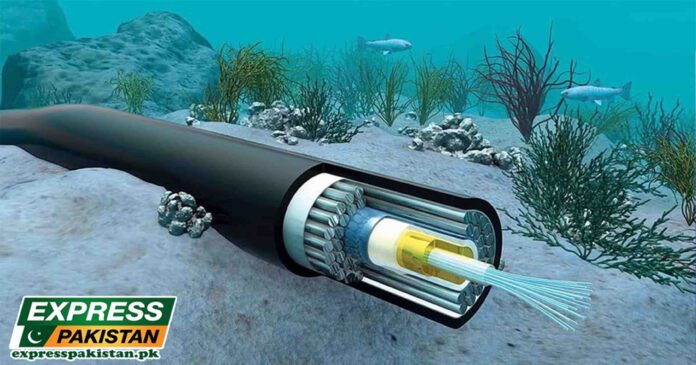
Pakistan plans to lay three new submarine internet cables in 2026 as part of a major infrastructure push to transform digital connectivity across the country. Federal Minister for IT and Telecommunication Shaza Fatima Khawaja announced the initiative, which aims to expand bandwidth capacity, reduce dependence on ageing infrastructure, and support the nationwide rollout of 5G services.
Why Does Pakistan Need New Submarine Cables?
Pakistan currently relies on seven fibre-optic submarine cables for its international internet connectivity. However, many of these cables are ageing systems such as AAE-1 and SMW-4, which have been prone to frequent outages and service disruptions. The country’s internet infrastructure has faced multiple high-profile disruptions in recent years due to cable faults, including incidents in early 2026 that caused nationwide slowdowns for extended periods. With over 150 million internet subscribers — making Pakistan the 7th-largest online population in the world — the demand for reliable, high-capacity connectivity is critical.
What the Three New Cables Will Deliver
The addition of three new submarine cables will significantly expand Pakistan’s international bandwidth capacity, improve redundancy so that a single cable fault no longer cripples national connectivity, and strengthen Pakistan’s ability to integrate with global data flows. Minister Khawaja stated that this initiative will not only boost internet speed but also ensure greater reliability, reduce service outages, and unlock broader economic potential for the country.
How This Supports 5G Rollout
One of the lesser-discussed requirements for 5G networks is the need for massive backhaul capacity — the high-speed connections that link mobile towers to the global internet. Submarine cables are the foundation of this backhaul. Without sufficient international bandwidth, 5G’s ultra-fast user speeds cannot be sustained end-to-end. The new cables will give Pakistan’s 5G networks the backbone they need to deliver on their performance promises, particularly for enterprise services, video streaming, and cloud applications.
Current Pakistani Submarine Cable Infrastructure
Transworld Home currently owns the TW1 submarine cable — the only privately owned submarine fibre optic cable in Pakistan — and serves as the landing party for the SMW-5 cable. The company also holds membership in the SEA-ME-WE 6 consortium and recently landed the 2Africa cable at its Hawksbay, Karachi cable landing station. PTCL operates the majority of Pakistan’s other submarine cable connections. Pakistan is also a beneficiary of the PEACE and 2Africa cables, which were launched by 2025.
When Will the New Cables Be Ready?
The government has confirmed 2026 as the target year for landing the three new cables. However, it has not yet disclosed specific timelines for each cable. Submarine cable projects are highly complex and involve international consortia, marine surveying, manufacturing, and landing operations. As a result, some cables may not reach full commercial operation until 2027.
Conclusion: The addition of three new submarine cables represents one of the most consequential upgrades to Pakistan’s digital infrastructure in years. For ordinary users, this means fewer outages, faster speeds, and a more resilient internet — benefits that will compound with the arrival of 5G services across major cities.