


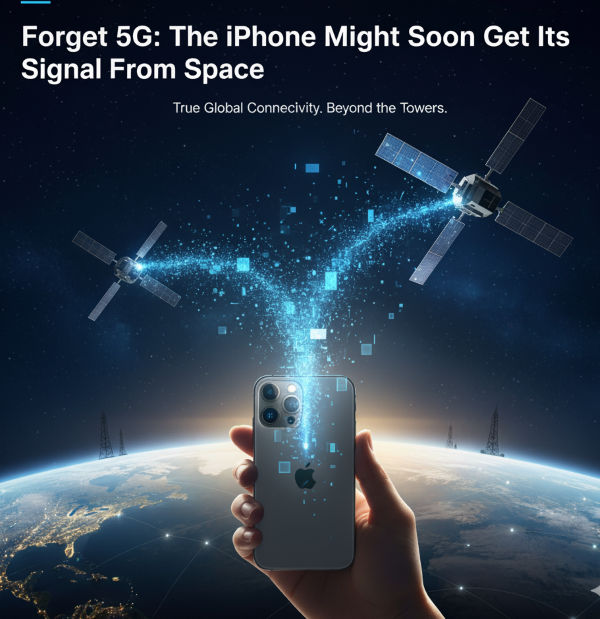
iPhone Satellite Signal Could Change Mobile Connectivity Forever
The iPhone satellite signal is emerging as one of the most disruptive technologies Apple has ever explored. While the world is still adapting to 5G, Apple appears to be looking far beyond cellular towers — straight into space. If current reports and industry leaks are accurate, future iPhones may rely on satellites rather than traditional mobile networks, potentially making 5G less relevant over time. This shift could completely redefine how smartphones connect to the internet, especially in remote and underserved regions.
What Is the iPhone Satellite Signal Technology?
The iPhone satellite signal refers to Apple’s efforts to allow iPhones to communicate directly with satellites orbiting Earth, without relying on mobile towers. Unlike existing cellular technology, this system could work anywhere — mountains, deserts, oceans, or disaster zones. Apple has already taken its first steps by introducing satellite-based Emergency SOS and location sharing. However, these features are currently limited to emergencies and text-based communication. The long-term vision appears far more ambitious.
Why Apple Is Moving Beyond 5G
Why the iPhone Satellite Signal Matters More Than 5G
5G promised ultra-fast speeds, but it has clear limitations: requires dense tower infrastructure, weak coverage in rural areas, and poor performance during disasters. The iPhone satellite signal eliminates many of these issues by offering global coverage directly from space. Instead of hopping between towers, your iPhone would connect to low-Earth-orbit satellites. This could mean no dead zones, no roaming charges, and reliable connectivity anywhere on Earth.
Apple and Starlink: A Potential Game-Changing Partnership
How Starlink Could Power the iPhone Satellite Signal
One of the strongest rumors suggests Apple may collaborate with SpaceX’s Starlink network, which already operates thousands of low-orbit satellites. Starlink’s technology is designed to deliver fast, low-latency internet across the globe. If Apple integrates Starlink capabilities into future iPhones, the iPhone satellite signal could evolve from emergency-only use to web browsing, messaging and calls, and streaming and cloud services. Such a move would instantly disrupt telecom companies worldwide.
Current iPhone Satellite Features Explained
Present-Day Use of iPhone Satellite Signal
Right now, Apple uses satellite connectivity in a limited way: Emergency SOS messaging, location sharing when off-grid, and roadside assistance in some regions. These features prove that iPhones already possess the hardware foundations needed for satellite communication. Apple is likely refining software, battery efficiency, and antennas before expanding full satellite internet access.
Future iPhones and Satellite Connectivity
When Will Full iPhone Satellite Signal Become Reality?
Industry analysts predict that advanced satellite connectivity could arrive between 2026 and 2027, possibly starting with premium models like the iPhone Pro lineup. Future upgrades may include voice calls via satellite, data access without cellular networks, and automatic switching between 5G and satellite. The target is reportedly the iPhone 18 Pro. Specifically, according to 9to5Mac, new Starlink satellite designs are in development to match Apple’s radio hardware.
Benefits of iPhone Satellite Signal for Users
Real-World Advantages
The expansion of the iPhone satellite signal could bring massive benefits: global internet coverage, improved emergency response, seamless travel connectivity, reduced reliance on telecom carriers, and better connectivity in developing regions. For people living in rural or disaster-prone areas, this technology could be life-changing.
Challenges Apple Still Faces
Despite the excitement, Apple must overcome several obstacles: battery consumption, regulatory approvals, network congestion, and cost of satellite access. Maintaining affordability while scaling the iPhone satellite signal globally will be Apple’s biggest challenge.
Will the iPhone Satellite Signal Kill 5G?
Is 5G Becoming Obsolete?
Not immediately. 5G will still dominate urban environments due to its speed and capacity. However, satellite connectivity could become the preferred fallback — or even primary — option in many scenarios. In the long run, the iPhone satellite signal may coexist with 5G rather than replace it completely, offering users the best of both worlds.
Final Thoughts: A Bold Leap Into the Future
Apple has always redefined technology rather than followed trends. The iPhone satellite signal represents another bold leap — one that could free users from network limitations forever. If Apple succeeds, future iPhones won’t just be smartphones; they’ll be globally connected devices powered by space. While full implementation may still be a few years away, the foundation is already being laid — and it’s clear that the future of connectivity is orbiting above us.