

5G spectrum auction Pakistan 2026: Results and Winners
The landscape of Pakistan’s telecommunications industry has reached a pivotal turning point. The 5G spectrum auction Pakistan 2026 has officially concluded, signaling a new era of connectivity that promises to reshape how we live, work, and communicate. As the cornerstone of the “Digital Pakistan” initiative, this auction was not merely a sale of airwaves but a strategic layout for the country’s technological future.
With over 240 million people increasingly relying on digital services for education, health, and commerce, the pressure on existing 4G networks has been immense. The successful completion of the 5G spectrum auction Pakistan 2026 provides the necessary bandwidth to relieve this congestion and introduce speeds that were once only possible via high-end fiber optic cables.
Winners of the 5G spectrum auction Pakistan 2026
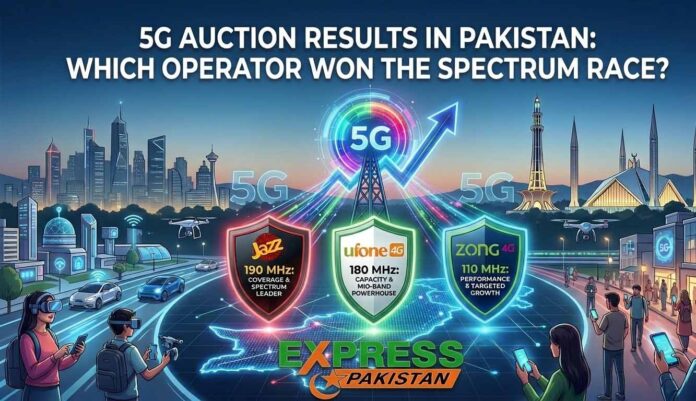
The auction results reveal a highly competitive market where each major mobile network operator (MNO) played to their specific strengths. A total of 480 MHz of spectrum was up for grabs, and the distribution among Jazz, Ufone 4G, and Zong 4G shows a clear vision for their respective 5G rollouts.
Jazz (The Coverage Leader)
Jazz, the nation’s largest mobile operator, has once again demonstrated its market dominance. By aggressively bidding in the 5G spectrum auction Pakistan 2026, Jazz secured a massive 190 MHz of total spectrum. What sets Jazz apart is their acquisition of the 700 MHz band. In the world of telecommunications, low-frequency bands like 700 MHz are considered “gold” because they can travel long distances and penetrate thick concrete walls. This move ensures that Jazz will likely lead the way in providing 5G coverage to rural areas and deep inside urban buildings where signals typically struggle.
Ufone 4G (The Speed Giant)
Ufone 4G, backed by PTCL, made a bold statement by securing 180 MHz of spectrum. Their strategy was heavily focused on the 3500 MHz band, where they secured the largest single portion among all competitors. This is a deliberate move to become the “speed leader.” The 3500 MHz band is the global standard for 5G performance, offering the massive capacity required for ultra-high-speed internet. Ufone is clearly targeting tech-savvy urban users, gamers, and businesses that require massive data throughput.
Zong 4G (The Urban Specialist)
Zong 4G has long been a pioneer of 4G in Pakistan, and their participation in the 5G spectrum auction Pakistan 2026 was equally strategic. By securing 110 MHz, primarily in the 2600 MHz and 3500 MHz bands, Zong is focusing on “capacity layers.” These bands are perfect for high-traffic environments like shopping malls, stadiums, and city centers. Zong’s approach suggests they are looking to provide a premium, consistent 5G experience in Pakistan’s most densely populated areas.
Understanding the Spectrum Bands
The success of the 5G spectrum auction Pakistan 2026 is best understood through the technical capabilities of the bands sold. Spectrum is the invisible highway that carries data, and different lanes (bands) serve different purposes.
| Frequency Band | Technical Strength | Primary Use Case |
| 700 MHz | Maximum Range | Rural connectivity and indoor penetration. |
| 2300/2600 MHz | Capacity and Range | General urban coverage and reliable mobile data. |
| 3500 MHz | Ultra-High Speed | 1 Gbps+ speeds, Gaming, and 4K Streaming. |
By spreading the spectrum across these bands, the Pakistan Telecommunication Authority (PTA) has ensured that the 5G rollout will be versatile enough to cover both the high-rise buildings of Karachi and the remote villages of Gilgit-Baltistan.
The Economic Impact of the 2026 Auction
The 5G spectrum auction Pakistan 2026 is more than a technical upgrade; it is an economic engine. Estimates suggest that the implementation of 5G could contribute billions of dollars to Pakistan’s GDP over the next decade.
For the freelance community—one of the largest in the world—5G means reliable, low-latency connections that allow for real-time collaboration with international clients. In the agriculture sector, 5G-enabled IoT (Internet of Things) devices can help farmers monitor soil moisture and crop health in real-time, drastically increasing yields. For the healthcare sector, the low latency of 5G makes telemedicine and even remote robotic surgeries a future possibility in Pakistan.
What Happens Next for Consumers?
Now that the 5G spectrum auction Pakistan 2026 is over, the physical work begins. You will likely see engineers upgrading cellular towers across major cities in the coming weeks. Here is what the average user can expect:
-
Revolutionary Download Speeds: Expect to download full-length HD movies in seconds rather than minutes.
-
The End of Lag: For online gamers, “ping” issues will become a thing of the past, as 5G offers near-instantaneous response times.
-
Improved 4G Performance: As high-data users migrate to the new 5G bands, the 4G network will have more “room to breathe,” leading to better performance for those who haven’t upgraded their phones yet.
-
Smart Homes: 5G allows for thousands of devices to connect simultaneously in a small area, making smart home devices like cameras, lights, and appliances work more seamlessly together.
Frequently Asked Questions (FAQ)
Do I need a new SIM card for 5G?
In most cases, your current 4G SIM will work, but you will need a 5G-enabled smartphone to access the new speeds.
When will 5G be available in my city?
Following the 5G spectrum auction Pakistan 2026, initial rollouts are expected in Islamabad, Karachi, and Lahore by mid-2026, with other cities following shortly after.
Will 5G packages be more expensive?
While initial “Early Access” plans might carry a premium, the increased capacity of 5G usually leads to lower costs per GB in the long run.
Conclusion: A Digital Leap Forward
The conclusion of the 5G spectrum auction Pakistan 2026 marks the start of a new chapter. With Jazz, Ufone, and Zong now equipped with the necessary spectrum, the race to launch the first commercial 5G service in Pakistan is on. This transition will empower the youth, stabilize the digital economy, and place Pakistan on the global map of advanced technological nations.