


Pakistan Taimoor Missile: What It Means for Regional Security and Military Balance
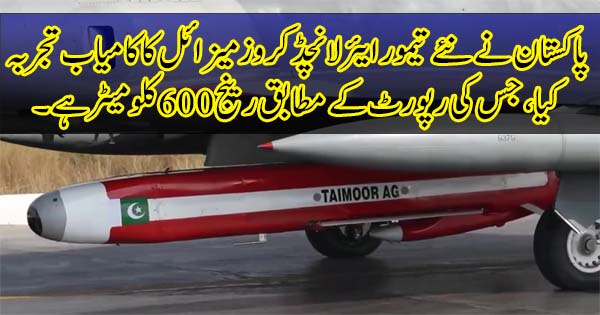
Pakistan has taken another significant step in strengthening its defense capabilities with the successful test of its new air-launched cruise missile, Taimoor. The test, conducted by the Pakistan Air Force (PAF), highlights the country’s continued focus on indigenous defense development amid evolving regional security challenges. Defense officials confirmed that the missile met all operational parameters during the trial, marking a key milestone in Pakistan’s ongoing military modernization efforts.
The successful test has drawn attention from regional and international defense observers, as cruise missile capabilities are increasingly viewed as critical elements of modern warfare. Pakistan’s leadership described the launch as part of routine testing, emphasizing that the country remains committed to maintaining credible deterrence while improving technological self-reliance.
What Is the Taimoor Missile?
The Taimoor missile is an indigenously developed air-launched cruise missile designed to engage both land-based and maritime targets with high precision. Cruise missiles differ from ballistic missiles in that they fly at relatively low altitudes and can follow complex flight paths, making them harder to detect and intercept.
According to defense sources, Taimoor is designed to be launched from fighter aircraft, giving it greater operational flexibility. Air-launched systems allow the launching platform to remain outside heavily defended areas while still striking targets at significant distances. This capability is increasingly important as modern air-defense networks become more advanced.
Key Features and Capabilities
While Pakistan has not released full technical specifications, officials involved in the test provided insight into the missile’s general capabilities. The Taimoor missile is believed to have a range of up to 600 kilometers, placing it among the longer-range air-launched cruise missiles in the region. Its low-altitude flight profile allows it to evade radar detection, while advanced guidance systems help ensure accuracy.
The missile is reportedly capable of striking both land and sea targets, expanding the Pakistan Air Force’s strike options across multiple domains. During the test, the missile’s navigation, guidance, and flight control systems were evaluated, and all performed as expected.
Importance of the Test for Pakistan
The successful test of Pakistan’s new missile carries both military and strategic significance. First, it demonstrates progress in indigenous defense production. Developing a modern cruise missile requires expertise in propulsion, avionics, guidance systems, and aerodynamics. The Taimoor project reflects years of investment in domestic research and engineering capabilities.
Second, the missile strengthens Pakistan’s ability to conduct stand-off strikes, allowing aircraft to launch weapons from safer distances. This reduces risks to pilots and aircraft while increasing mission effectiveness. In modern air warfare, stand-off capabilities are considered essential, especially in contested environments.
Third, the test reinforces Pakistan’s stated goal of maintaining a credible deterrence posture. Defense planners often argue that precision-guided weapons help prevent conflict by discouraging aggression through the ability to respond effectively if required.
Regional Security Context
South Asia remains a region marked by complex security dynamics and rapid military modernization. Several countries in the region are investing heavily in missile technology, advanced aircraft, and air-defense systems. Against this backdrop, Pakistan’s test of the Taimoor missile is likely to be carefully analyzed by neighboring states.
Military analysts note that longer-range air-launched cruise missiles can influence strategic calculations by enhancing flexibility and survivability. Such weapons allow air forces to conduct precision strikes without crossing heavily defended borders, potentially altering traditional operational concepts.
Pakistan has maintained that its missile tests are defensive in nature and aimed at ensuring national security rather than escalating tensions. Nevertheless, developments in missile technology often have broader implications for regional stability.
Role of the Pakistan Air Force
The Pakistan Air Force has played a central role in integrating advanced weapons into its operational fleet. The Taimoor missile test highlights the PAF’s growing emphasis on precision, technology, and multi-role capabilities. Officials stated that the test evaluated not only the missile itself but also its integration with aircraft systems, mission planning, and command-and-control procedures.
Such integration tests are critical before a weapon system can be formally inducted into service. They ensure that pilots, ground crews, and support systems can operate the weapon effectively under real-world conditions.
How Taimoor Fits into Pakistan’s Missile Program
Pakistan’s missile program includes a wide range of systems designed for land, sea, and air platforms. Over the years, the country has tested short-range and long-range missiles, as well as cruise missiles intended for different operational roles.
The Taimoor missile complements existing systems by expanding the air-launched segment of Pakistan’s arsenal. By diversifying delivery platforms, military planners aim to enhance resilience and flexibility. This approach reduces reliance on any single system and improves overall deterrence capability.
International Observations
Although there was no immediate international reaction following the test, defense experts around the world are monitoring Pakistan’s missile developments. Cruise missile tests often attract attention due to their potential impact on regional security and arms control discussions.
Analysts emphasize the importance of transparency and communication to prevent misunderstandings, particularly in regions with a history of military rivalry. Pakistan has traditionally announced missile tests through official channels to avoid misinterpretation.
What Comes Next?
Following a successful initial test, missile programs typically undergo additional trials under varying conditions. These tests help assess reliability, accuracy, and performance across different scenarios. Further evaluations may be conducted before the missile is formally inducted into operational service.
If future tests confirm its effectiveness, the Taimoor missile could become a key component of the Pakistan Air Force’s strike capability, supporting long-term modernization goals.
The successful test of Pakistan’s new Taimoor missile represents an important development in the country’s defense landscape. With its reported long range, low-altitude flight profile, and precision strike capability, the missile enhances Pakistan’s air-launched operational options.
As regional militaries continue to modernize, the introduction of systems like Taimoor underscores the growing importance of advanced cruise missiles in contemporary defense strategies. While many technical details remain undisclosed, the test itself signals Pakistan’s continued focus on strengthening indigenous military capabilities.