

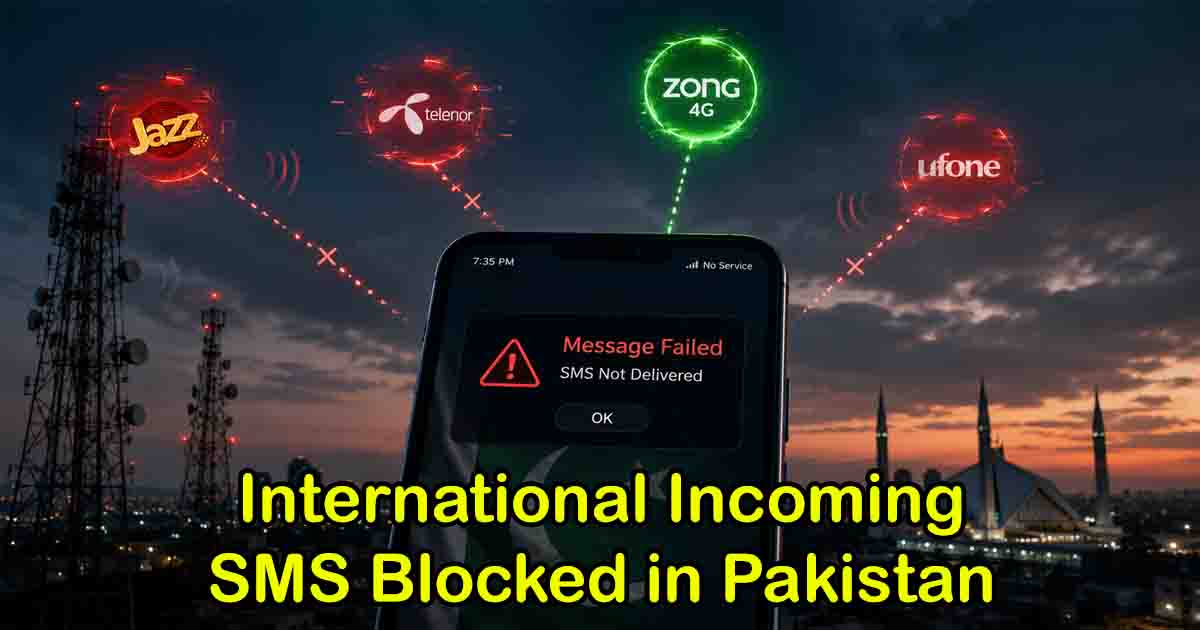
International SMS Not Working in Pakistan — Zong, Ufone & Telenor Fail while Jazz remains unaffected
International incoming SMS are failing to deliver across Pakistan on three major mobile networks. Subscribers of Zong, Ufone, and Telenor Pakistan are no longer receiving text messages from foreign numbers — while Jazz users continue to get international incoming SMS with no disruption at all.
The complaints are mounting fast. Users in Karachi, Lahore, Islamabad, Peshawar, and Quetta report the same alarming experience: messages sent from the US, UK, Canada, UAE, and Saudi Arabia simply never arrive.
Which Networks Are Affected?
Zong, Ufone, and Telenor Pakistan subscribers are at the centre of this crisis. International incoming SMS are being silently dropped across all three networks.
Jazz — Pakistan’s largest mobile operator with over 74 million subscribers — is confirmed to be completely unaffected [As of now]. Jazz customers are receiving international incoming SMS normally from the same foreign numbers that Zong, Ufone, and Telenor users cannot receive.
This stark divide strongly suggests the problem lies within each affected carrier’s routing infrastructure or filtering system — not with foreign senders or global networks.
Real Users, Serious Losses
The damage caused by blocked international incoming SMS goes far beyond missed personal conversations.
A Zong subscriber in Lahore discovered his family in the United Kingdom had been texting him for days. He only found out through a WhatsApp call. “Not a single SMS came through — no notification, no missed alert, nothing,” he said.
A Telenor user in Islamabad reported that international incoming SMS carrying OTPs from his bank and online platforms stopped arriving, locking him out of accounts he urgently needed to access.
Freelancers, overseas Pakistani families, remote workers, and students who depend on international incoming SMS for two-factor authentication and daily communication with people abroad are bearing the worst of this failure.
What Is Causing the Failure?
Telecom analysts point to three credible explanations.
Collapsed SMS Gateway Agreements. Operators use international SS7 interconnects and third-party SMS gateways to route cross-border messages. If a contract has lapsed or been misconfigured on the Zong, Ufone, or Telenor side, international incoming SMS will fail silently — with no error shown to the sender.
Overly Aggressive Sender Filtering. Pakistani carriers apply sender ID filters under PTA guidance to block spam. When applied too broadly, these filters end up blocking genuine international incoming SMS — including personal texts, OTPs, and alerts from banks, Google, and PayPal.
Declining Network Availability. Data recently presented to Pakistan’s National Assembly shows all three carriers are falling below PTA’s mandatory 99% availability threshold. Zong sits at just 96.86%, Ufone at 97.6%, and Telenor at 98.1% — all degraded further by persistent nationwide power outages knocking towers offline.
Operator-Level Troubleshooting Checklist
For Zong, Ufone, and Telenor technical teams, here is a structured checklist to diagnose why international incoming SMS are not being delivered — and to rule out whether the issue is operator-side or government-directed.
1. Verify International SMS Routing Is Active Check that the SS7 SCCP and SMSC (Short Message Service Centre) routing tables are correctly configured for foreign MCC/MNC pairs. Run a live test using a foreign SIM from the UK, UAE, and US to confirm whether DELIVER_SM messages are actually reaching the SMSC from the international gateway.
2. Audit the SMS Firewall and Filtering Rules Review the SMS firewall rule-sets in use on each carrier’s A2P and P2P international routes. Confirm that no blanket block has been applied to international originating addresses (international TON/NPI settings). A misconfigured filter blocking all alphanumeric or international numeric sender IDs is a common cause of silent delivery failure.
3. Check SMSC Logs for Delivery Receipts Pull SMSC delivery receipt logs for the affected time period. If international incoming SMS are arriving at the SMSC but not being pushed to the handset, the failure is in the last-mile delivery layer — typically a HLR (Home Location Register) lookup issue or a subscriber profile misconfiguration. If messages are not even reaching the SMSC, the break is upstream at the gateway or interconnect level.
4. Test the International Roaming Hub and IPX Connectivity Verify that the IPX (IP Packet Exchange) interconnect with international SMS hub providers — such as BICS, Syniverse, or Tata Communications — is live and passing traffic. Run PING and trace tests on the GRX/IPX links. A broken or throttled IPX connection will silently discard all inbound international SMS before they ever reach the local SMSC.
5. Confirm No PTA or Government-Level Block Is in Place This is the critical step. Operators must formally query the PTA’s NGMS (Next Generation Monitoring System) and their own lawful intercept management interface to confirm whether any directive has been issued to block or filter international incoming SMS at the national gateway level. If no such directive exists in writing, the issue is technical — not regulatory — and must be resolved by the operator immediately.
6. Cross-Check with a Working Operator Since Jazz is confirmed to be delivering international incoming SMS normally, Zong, Ufone, and Telenor technical teams should run parallel delivery tests using the same foreign test numbers against both their own network and Jazz. Any message successfully delivered to Jazz but not to the affected carrier is definitive proof that the problem is carrier-side, not a sender issue or a government block.
7. Review Recent SMSC or Firewall Configuration Changes Check the change log on all SMSC, SMS firewall, HLR, and STP (Signal Transfer Point) systems for any configuration updates made in the days leading up to when complaints began. A recently pushed firewall update, a routing table flush, or a software patch rolled out without full regression testing is frequently the root cause of sudden, widespread SMS delivery failures.
Pakistan’s 5G Launch Is Making Things Worse
Pakistan’s freshly launched 5G network adds a dangerous new layer to the international incoming SMS crisis — and foreign companies and global users sending messages to Pakistan are already feeling the consequences.
On March 19, 2026, Jazz and Zong simultaneously became Pakistan’s first commercial 5G operators, launching services across Islamabad, Karachi, Lahore, and more than 16 major cities. Ufone followed shortly after receiving its own commencement letter from the PTA. According to the Ministry of IT, Pakistan’s 5G rollout will be executed in four phases, with operators expected to deploy roughly 3,000 new network sites annually and meet a mandatory minimum 5G data rate of 50 Mbps.
On paper, this is a landmark moment. But on the ground, the timing could not be worse.
A Network in Transition Is a Network Under Stress. The simultaneous rollout of 5G across multiple operators while existing 4G infrastructure is still carrying the country’s full subscriber load creates intense pressure on core network systems — including the SMSC nodes, SS7 signalling layers, and HLR databases that handle international incoming SMS delivery. When engineers are reconfiguring core network elements to support 5G NR (New Radio) architecture, misconfigurations in legacy SMS routing pathways are a well-documented risk.
IMS and VoNR Transition Creates SMS Blind Spots. As Pakistani operators migrate towards 5G’s IMS (IP Multimedia Subsystem) core and VoNR (Voice over New Radio), the traditional SS7-based SMS channel that carries international incoming SMS faces a critical hand-off problem. If the SMS interworking function between the new 5G core and the legacy SMSC is not correctly implemented, international SMS traffic falls into a gap — delivered to no one, flagged as delivered by no one.
Foreign Companies Face a Serious Reliability Risk. Pakistan’s telecom sector crossed Rs1 trillion in revenue in 2024–25, with over 200 million subscribers and a telecom industry currently valued at $4.52 billion, projected to grow at a CAGR of 3.28% through 2033. International businesses — banks, fintech platforms, e-commerce companies, and enterprise software providers — that rely on SMS-based OTP delivery or transactional alerts to Pakistani users are now facing a market where international incoming SMS simply do not arrive reliably on three of the four major networks.
For any foreign company running SMS-based authentication or customer communication into Pakistan, this is a critical business continuity issue. Delivery rates on Zong, Ufone, and Telenor cannot be trusted until the 5G transition stabilises and the underlying SMS routing failures are resolved.
The 5G Promise Cannot Be Built on a Broken SMS Foundation. Pakistan has set an ambitious target of $700 million in revenue from 5G spectrum and wants to position itself alongside other leading digital economies in Asia. But global digital confidence in Pakistan’s network depends on basic reliability — and right now, international incoming SMS on three major networks is anything but reliable.
Carriers and PTA Stay Silent
None of the three affected carriers has publicly acknowledged the international incoming SMS failure. Users who called helplines were told to restart their phones or simply wait — doing nothing to resolve the issue.
The Pakistan Telecommunication Authority (PTA), mandated to enforce service quality and protect consumers, has also offered no statement at the time of publication.
For users who rely on international incoming SMS for critical digital access and family communication, this silence is unacceptable.
What Affected Users Can Do Today
File a formal PTA complaint. Visit complaint.pta.gov.pk or call 0800-55055. Every complaint filed increases regulatory pressure on operators to act.
Escalate with your carrier. Call Zong at 310, Ufone at 333, or Telenor at 345. Demand a Level 2 technical escalation — a basic troubleshooting response is not acceptable here.
Use a Jazz SIM as a workaround. Jazz is confirmed to be delivering international incoming SMS reliably. Using a Jazz number temporarily for OTPs and foreign contacts is the most effective short-term fix.
Switch to internet-based messaging. WhatsApp, iMessage, and Signal bypass carrier SMS entirely and work over mobile data or Wi-Fi regardless of this outage.
The Public Deserves Answers
Pakistan’s consumer and digital rights community is demanding urgent accountability. Is this a technical failure, a regulatory instruction, or plain operator negligence?
“Families abroad are texting loved ones in Pakistan and the messages are disappearing,” said one consumer advocate tracking the issue. “People are being locked out of their own bank accounts. The operators and the PTA owe the public a full and immediate explanation.”
International incoming SMS on Zong, Ufone, and Telenor Pakistan remain blocked for a growing number of users as of today. This is a critical, unresolved failure — and affected users deserve both transparency and urgent action.
